
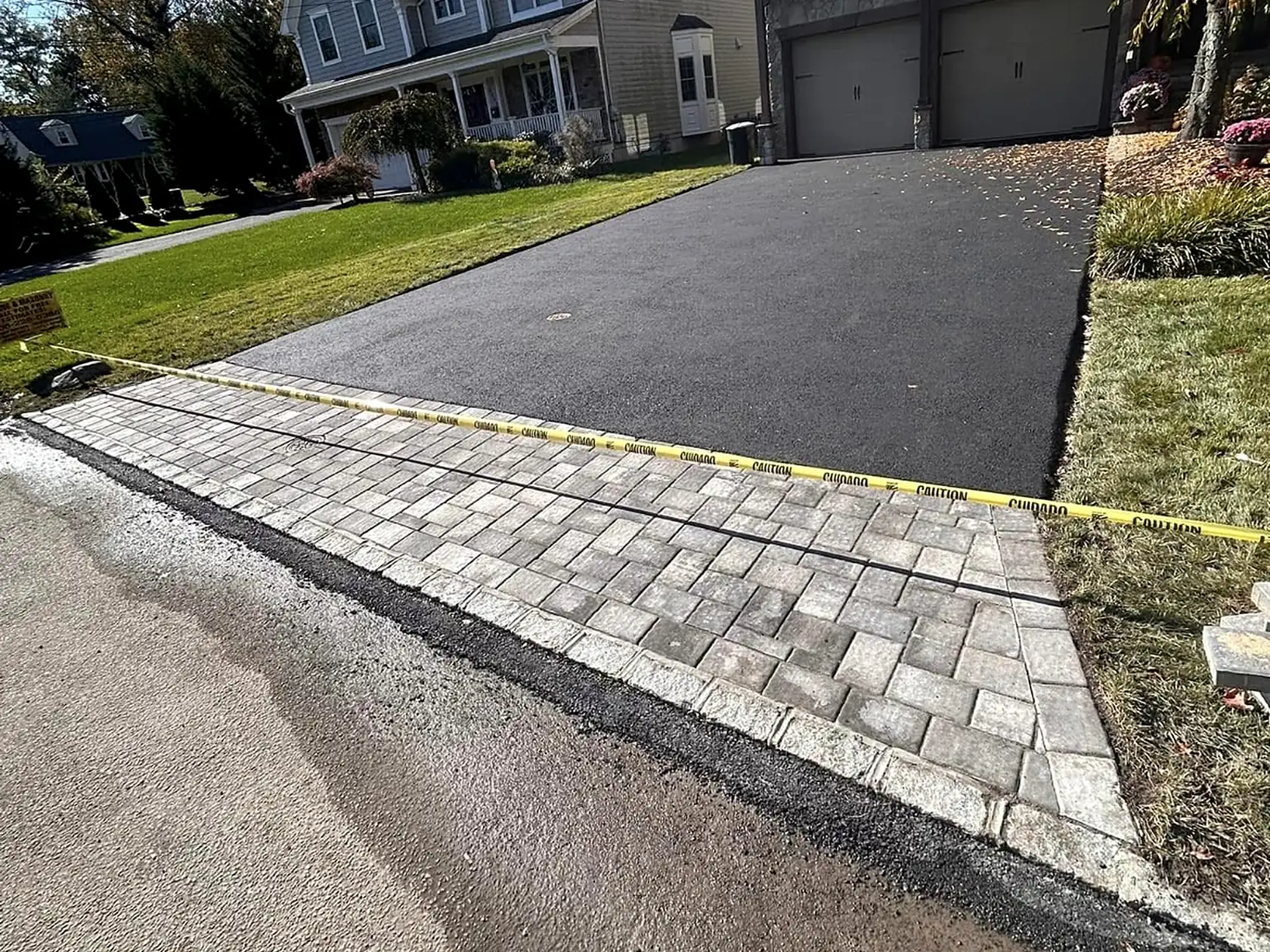
Ask three contractors how long an asphalt driveway lasts and you will get three numbers. The range usually quoted is somewhere between fifteen and thirty years, and that spread is not vagueness. It is the difference between a driveway built on a proper base and one that was not.
What is the average lifespan of an asphalt driveway?
In New Jersey conditions, a residential asphalt driveway that was excavated properly, based in compacted stone and pitched to drain will generally give you the top half of that range. One laid thin, over soft ground, with water sitting on it every winter, can be visibly failing in under ten years.
The surface is not what usually gives out. What gives out is what is under it.
What affects asphalt driveway lifespan in Montclair?
- The base. Depth and compaction of the stone underneath decide more than anything else. A base built in one thick uncompacted lift looks identical on day one and behaves nothing like a properly compacted one in year three.
- Drainage. Water that sits is water that gets into the surface, freezes, expands and levers it apart. Pitch is not decoration.
- What drives on it. A driveway carrying two cars is a different specification from one taking a delivery truck or a contractor's dumpster.
- Edges. Unsupported asphalt edges crumble first, especially where cars turn.
- Tree roots. Common on older Montclair streets, and they will telegraph through a surface laid over them.
- Sealing. Sensible sealing extends life. Sealing on a marketing schedule rather than a real one does not.
How does Montclair weather affect an asphalt driveway?
New Jersey winters are hard on asphalt in a specific way. It is not the cold, it is the crossing. Our winters move above and below freezing repeatedly rather than staying cold, and every crossing is another cycle of water getting into the surface, expanding as it freezes, and opening what it got into a little further.
Add road salt tracked up the driveway from December onward, then summer sun oxidising the surface and making it brittle, and you have three separate mechanisms working on the same driveway across a single year.
Montclair adds one more. The town sits on the Watchung ridge, so a great many driveways here slope, and a sloped driveway that was graded carelessly delivers all of that water to one place.
How can you extend the life of an asphalt driveway?
- Keep water moving off it. Clear the edges, keep drains clear, and make sure downspouts are not discharging onto it.
- Seal it on a sensible interval rather than annually. Sealing is protective, not structural, and more is not better.
- Deal with cracks while they are still cracks. Water in a crack is how a crack becomes a pothole.
- Keep heavy vehicles off the edges, which is where the support is weakest.
- Use a plastic shovel blade rather than a metal one, and go easy on the rock salt.
What are the signs an asphalt driveway is near the end?
Isolated cracks and the occasional pothole are maintenance. The signals that the base has gone are different:
- Alligator cracking, a network of connected cracks like reptile skin, across a large area rather than one patch
- Potholes that keep coming back in the same spot after being filled
- Areas that have visibly sunk, or that hold water after every storm
- Edges crumbling along most of the length rather than at one corner
- A surface that has been patched so often it is more patch than driveway
Should you repair, resurface or replace?
Repair when the damage is isolated and the rest of the driveway is sound. Driveway repair covers crack filling, patching and edge work. Crack filling and patching are cheap and buy real time.
Resurface when the surface is worn and tired but the base underneath is still doing its job. A new wearing course over a sound base costs a fraction of a replacement.
Replace when the base has failed. That is a full asphalt driveway replacement, built from the subgrade up. Alligator cracking across the field, sinking, recurring potholes and standing water all point the same way, and resurfacing over a failed base simply reproduces the same cracks in the same places within a couple of seasons.
If you are not sure which of the three you are looking at, that is exactly what an estimate is for, and our pricing page explains what moves the number. We would rather tell you it is a repair than sell you a replacement.
Frequently asked questions
Can I seal a brand new driveway?
Not immediately. New asphalt needs to cure first, and sealing it too early works against that. We will give you the timing for your driveway rather than a rule of thumb.
How often should I seal?
Less often than most sealing companies suggest. It depends on sun, traffic and how the surface is actually holding up, which is worth looking at rather than scheduling blindly.
Will resurfacing fix my cracks permanently?
Only if the cracks are a surface problem. If they are coming from a failed base, they will come back through the new surface.
Does a paver border actually help?
Yes, and it is one of the more useful details you can add. It supports the edge, which is where asphalt fails first, and it looks considerably better than a raw asphalt lip.