
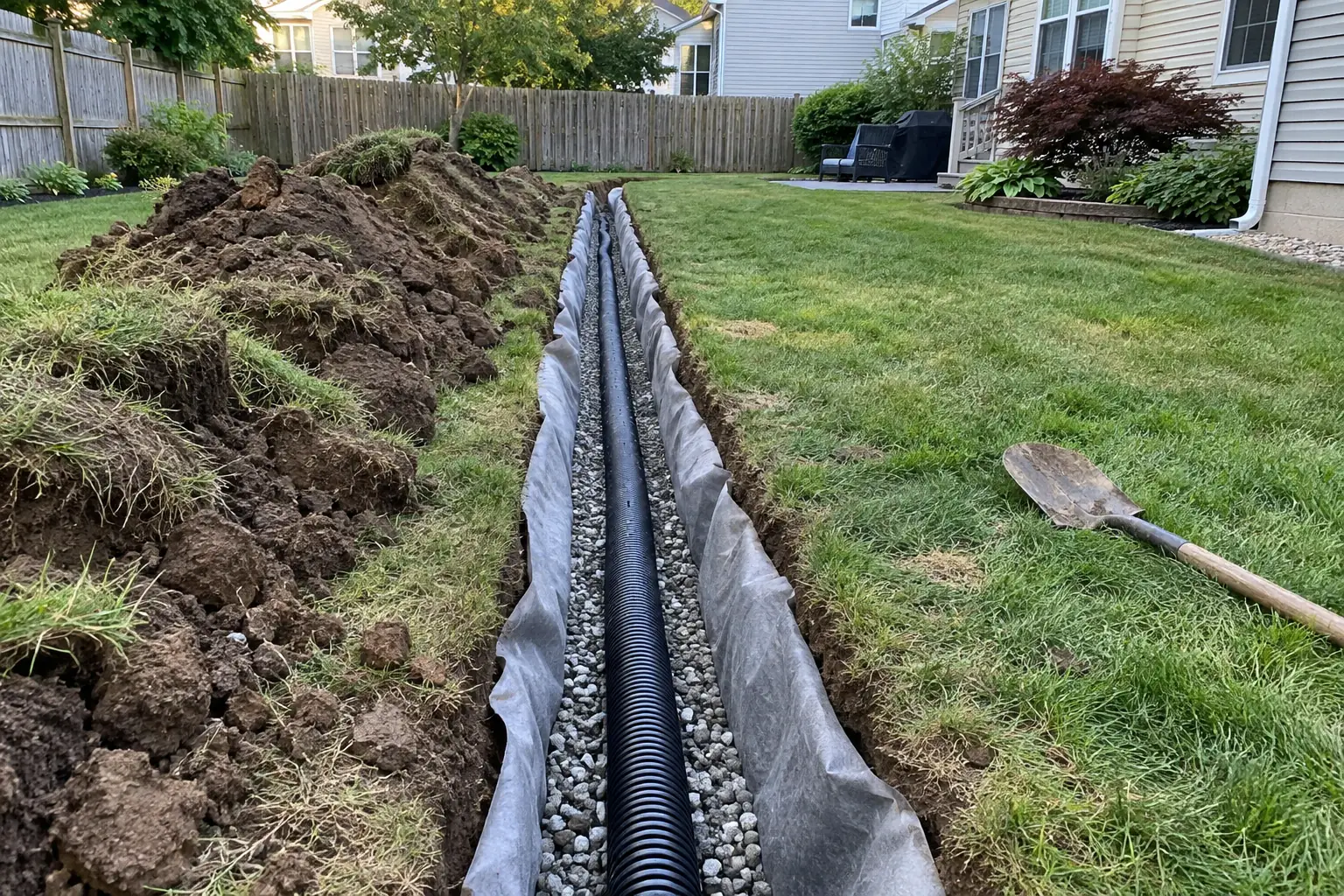
French drain installation
A pipe in stone that gives water an easier path than the one it is taking now.
How a French drain works
A French drain is a trench lined with filter fabric, bedded with washed stone, with a perforated pipe running through the stone. Water in the surrounding soil finds the stone easier to move through than the ground around it, drops into the pipe, and follows the pipe's fall to wherever it discharges. The fabric keeps soil from silting up the stone, which is what kills most drains that fail early.
The discharge is the part that decides whether the drain works. A French drain has to run downhill to somewhere lower and sensible: a point where the ground falls away, a dry well, or a sump that can pump it out. A drain with nowhere to go just collects water in a new place.
Two kinds of French drain
Yard drains run across or around a lawn to intercept water before it reaches the house, or to dry out a low spot that stays wet for days after rain. They sit relatively shallow, usually somewhere around a foot and a half to two feet deep, depending on the slope and the soil.
Footing drains run along the base of the foundation, outside or inside, at the level of the footing, to relieve water pressure against the basement wall. Outside, they go in when the wall is excavated for exterior waterproofing. Inside, they are cut in along the edge of the basement floor and run to a sump.
Doing it right
- A continuous fall toward the discharge, so water never sits in the pipe
- Filter fabric around the stone, so soil cannot clog it
- Washed, clean stone rather than whatever came out of the trench
- A cleanout where the run is long, so the pipe can be flushed
- Utilities marked before anyone digs. In New Jersey that is a free call to 811, and it is required.
Common questions
How much will it cost to install a French drain?
It depends on the length and depth of the run, how hard the digging is, what the trench crosses (lawn, beds, paving), and where the water has to discharge. A shallow yard drain and a footing drain are very different jobs. We look at the site and give you a written price. See what drives the price.
How deep does a French drain need to go?
A yard drain usually sits around a foot and a half to two feet deep. A footing drain goes down to the level of the foundation footing. The right depth depends on what water you are trying to catch and where it can discharge.
What are the downsides of a French drain?
It can clog if the fabric or stone is wrong, it needs a place to discharge, and it means digging a trench through whatever is in the way. It is also the wrong answer to a problem that is really a downspout or a bad grade, which cost much less to fix.
Where should you not put a French drain?
Anywhere it cannot discharge downhill, anywhere it would dump water onto a neighbor's property, and anywhere near buried utilities or a septic field without marking them first. It is also pointless in a spot where the real problem is roof water that a gutter extension would fix.
What can I do instead of a French drain?
Often something cheaper. Extending downspouts, regrading soil away from the house, or repitching a patio or driveway fixes a lot of drainage problems on its own. A shallow swale or channel drain handles surface water that runs across a yard rather than soaking through it.
Can I install my own French drain?
A short, shallow yard drain is a fair homeowner project if the slope and discharge are clear. Footing drains, long runs and anything near the house or utilities are better left to a crew, because the fall and the discharge are where these projects go wrong.
This page was last updated in September 2026.
A soggy yard or a wet wall?
Call (973) 489-3642. We will tell you whether a drain is the answer before we dig one.