
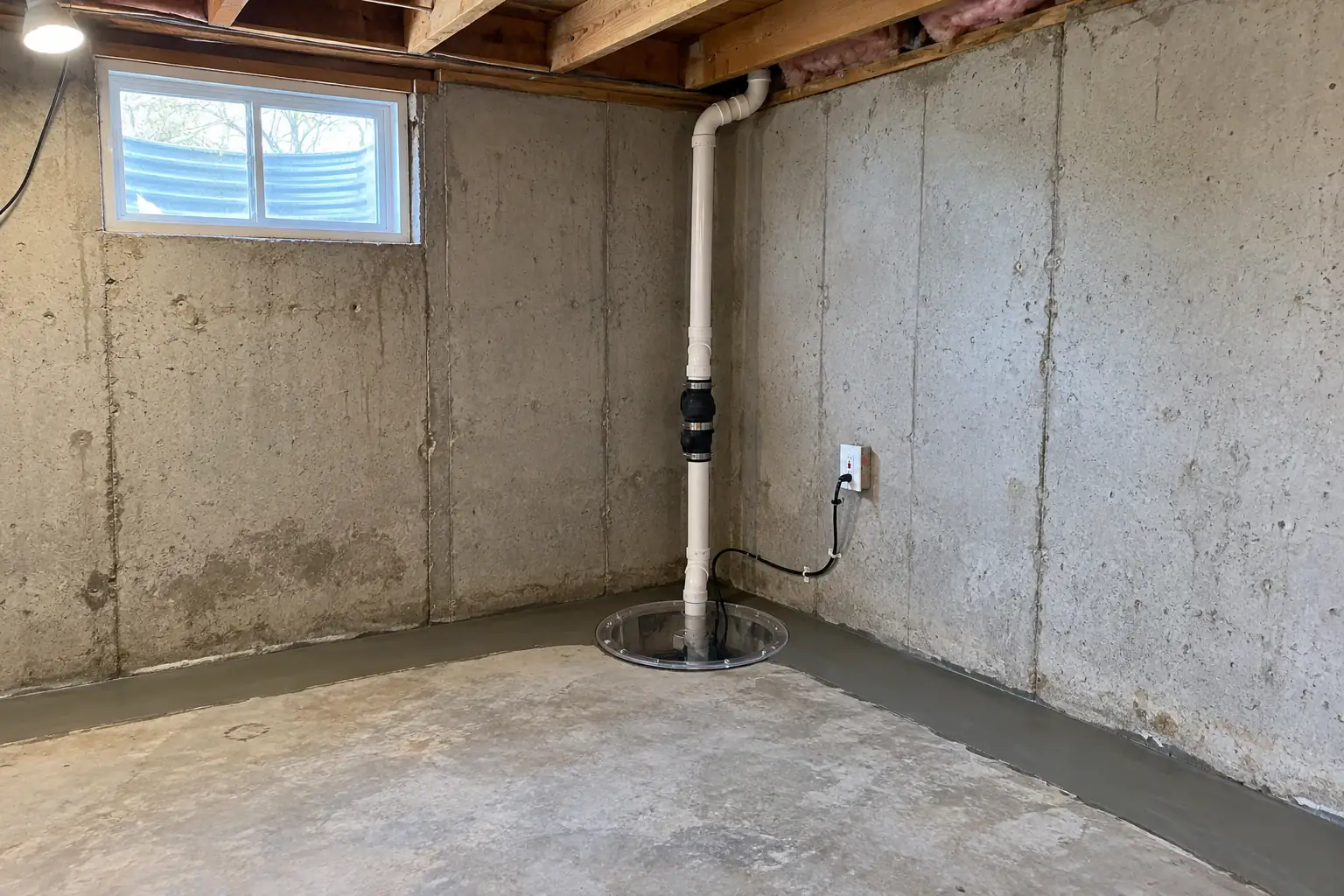
Sump pump installation
The storm that floods a basement is often the storm that takes the power out. Plan for both.
What a sump system actually is
A sump pump is the last step in a drainage system. Water collected by an interior drain along the footing, or rising from under the slab, flows into a pit set below the basement floor. When the water in the pit rises, a float switches the pump on, and the pump pushes the water up and out of the house through a discharge line. When the level drops, it switches off.
Every part of that chain can fail, and most sump problems are not the pump itself. It is a pit too small for the water coming in, a float that jams against the side, a check valve that lets water fall back, or a discharge line that freezes or empties right back against the foundation.
What a proper installation includes
- A pit cut below the slab, with a lined basin, sited at the low point of the basement where the drainage runs to
- A sealed lid, which keeps debris out, cuts noise and stops damp air rising into the basement
- A pump sized for the water and the height it has to lift it, not the cheapest one on the shelf
- A check valve on the discharge, so the water just pumped out does not fall back into the pit
- A discharge line that cannot freeze and ends well away from the house, where the ground falls away, so the same water is not circulated back to the wall
- A battery backup worth discussing, because a pump without power is an ornament in exactly the storm you bought it for
When a sump is the answer, and when it is not
A sump pump is the right tool where water cannot be stopped outside: high ground water, springs, or a basement below the level the yard drains to. It is paired with an interior drain along the footing, covered on our basement waterproofing page. If your water comes from a downspout at the wall or ground sloping toward the house, a pump treats the symptom and runs forever. We will tell you which yours is before recommending one.
Common questions
How much does it cost to install a sump pump?
Replacing a pump in an existing pit is a small job. A new system, with a pit cut through the slab, interior drainage run to it, and a discharge line through the wall, is a much bigger one. Battery backup adds to either. We give you a written price once we have seen the basement. See what drives the price.
What is the average lifespan of a sump pump?
Commonly around seven to ten years, less for a pump that runs constantly. Test it each spring by pouring water into the pit and watching it switch on and off. A pump that is old, noisy, or cycling far more than it used to is worth replacing before it fails, not after.
What are common sump pump installation mistakes?
A pit too small for the inflow, so the pump short cycles and burns out. No check valve. A discharge line that freezes, or empties next to the foundation so the same water comes straight back. A float that catches on the pit wall. No thought given to a power cut.
How deep should a sump pump pit be?
Deep enough that the pump sits below the drain lines feeding it and the basement floor, so water reaches the pit before it reaches the slab. The rim of the basin sits flush with the finished floor, under a sealed lid.
What is a better alternative to a sump pump?
Where the water can be stopped outside, fixing it there is better, because nothing mechanical is involved. Grading, downspout extensions and exterior drainage all remove water without a motor. Where the water table is simply high, a pump is the answer.
Can I install a sump pump myself?
Swapping a failed pump in an existing pit is a common homeowner job. Cutting a new pit through the slab and tying in drainage and a discharge through the wall is a construction job, and getting the discharge wrong puts the water back against the house.
This page was last updated in September 2026.
Pump running nonstop, or no pump at all?
Call (973) 489-3642. We will tell you whether it needs a pump, a better pit or a fix outside.