
Waterproofing basements in New Jersey
The cheapest fix is often outside the house. We look there first.
A wet basement is a drainage problem before it is a foundation problem
A surprising share of wet basements in New Jersey are fixed outside the house. A downspout discharging at the wall, ground graded back toward the foundation, a patio or driveway pitched the wrong way, a blocked gutter: any of those will put water against a wall day after day, and no amount of interior sealing changes it.
So waterproofing starts with finding the source. When does the water show up, and where? Water that arrives only in heavy rain usually points at surface drainage. Water that appears every spring and lingers points at ground water. Dampness on the walls with no standing water can be condensation, which is a ventilation question rather than a waterproofing one.
The three ways to keep a basement dry
Stop it outside, at the surface. Regrade soil so it falls away from the house. Extend downspouts or run them underground to daylight. Repitch the driveway, patio or walk that sheds water toward the wall. Where the source is outside, this is the cheapest and most permanent answer, and it is the one we look for first.
Stop it at the wall, from outside. Excavate down the foundation, clean the wall, apply a waterproofing membrane and drainage board, and lay a footing drain in stone to carry water away. It is the most thorough fix for a wall taking water through its full height, and the biggest job, because the wall has to be dug out.
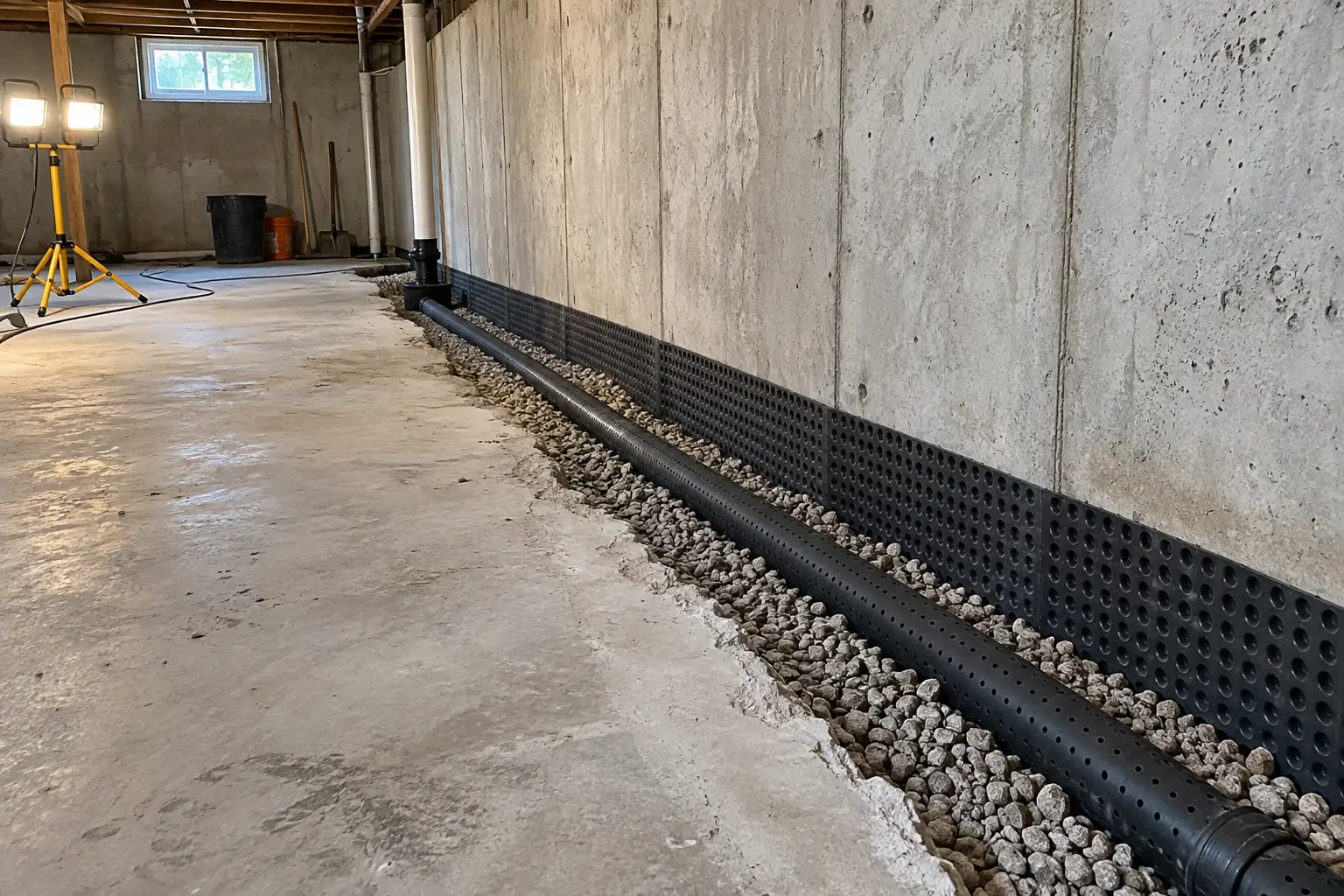
Manage it inside. Where water cannot be stopped outside, an interior drain is cut in along the footing, set in stone, and taken to a sump pump that sends it out of the house. It does not stop water reaching the wall. It gives it a controlled path so it never reaches the floor.
Coatings and sealers
Waterproof paints and masonry sealers are the product most people try first, and they are worth understanding. They can help with dampness on the face of a wall. They cannot hold back water under pressure from saturated soil, and on a wall that is actively leaking they tend to blister and peel. If a sealer has not fixed it, that is useful information about the source, not a reason to buy a thicker one.
Cracks and wall penetrations
Water often comes in at a single point: a crack in a poured wall, a pipe coming through the foundation, or the joint where the wall meets the floor. A single leaking crack is a repair, not a system. See foundation crack repair for how we tell a water crack from a structural one.
Common questions
What is the best waterproofing method for a basement?
The one that deals with where your water is coming from. Surface water is best fixed outside with grading and downspouts. A wall taking water through its height is best fixed with exterior waterproofing. High ground water that cannot be stopped is managed with interior drainage and a sump. There is no single best method, which is why we look first.
What is the average cost to waterproof a basement?
It spans a very wide range, from extending downspouts to excavating a wall, so an average is not much use. The price depends on the source of the water and how much of the basement is affected. We give you a written price once we know which fix you need. See what drives the price.
Can a basement be waterproofed from the inside?
Yes, with interior drainage and a sump pump, which collects water at the footing and pumps it out. It manages water rather than stopping it at the wall, which is the right approach for some houses and the wrong one for others.
How do I stop water from seeping through my basement walls?
Start outside. Check that downspouts discharge well away from the house and that the soil and paving slope away from the wall. If water still comes through, the fix is exterior waterproofing or interior drainage, depending on how the water is getting in.
What is the cheapest way to waterproof basement walls?
Fixing the drainage outside, where that is the cause. Downspout extensions and regrading cost far less than any wall treatment. A coating is cheaper still, but it only helps with surface dampness.
What is better than Drylok for basement walls?
For real water, not a coating at all. Masonry sealers deal with dampness on the face of the wall. Water pushed through by saturated soil needs the source dealt with outside, a membrane on the exterior of the wall, or an interior drain.
My basement only floods in heavy rain. Is that serious?
It is a signal worth acting on rather than an emergency. Water that only arrives in heavy rain usually points at surface drainage, which is the cheaper end of this work.
This page was last updated in September 2026.
Wet basement after every storm?
Call (973) 489-3642. We will find where it is coming from before quoting anything to stop it.