
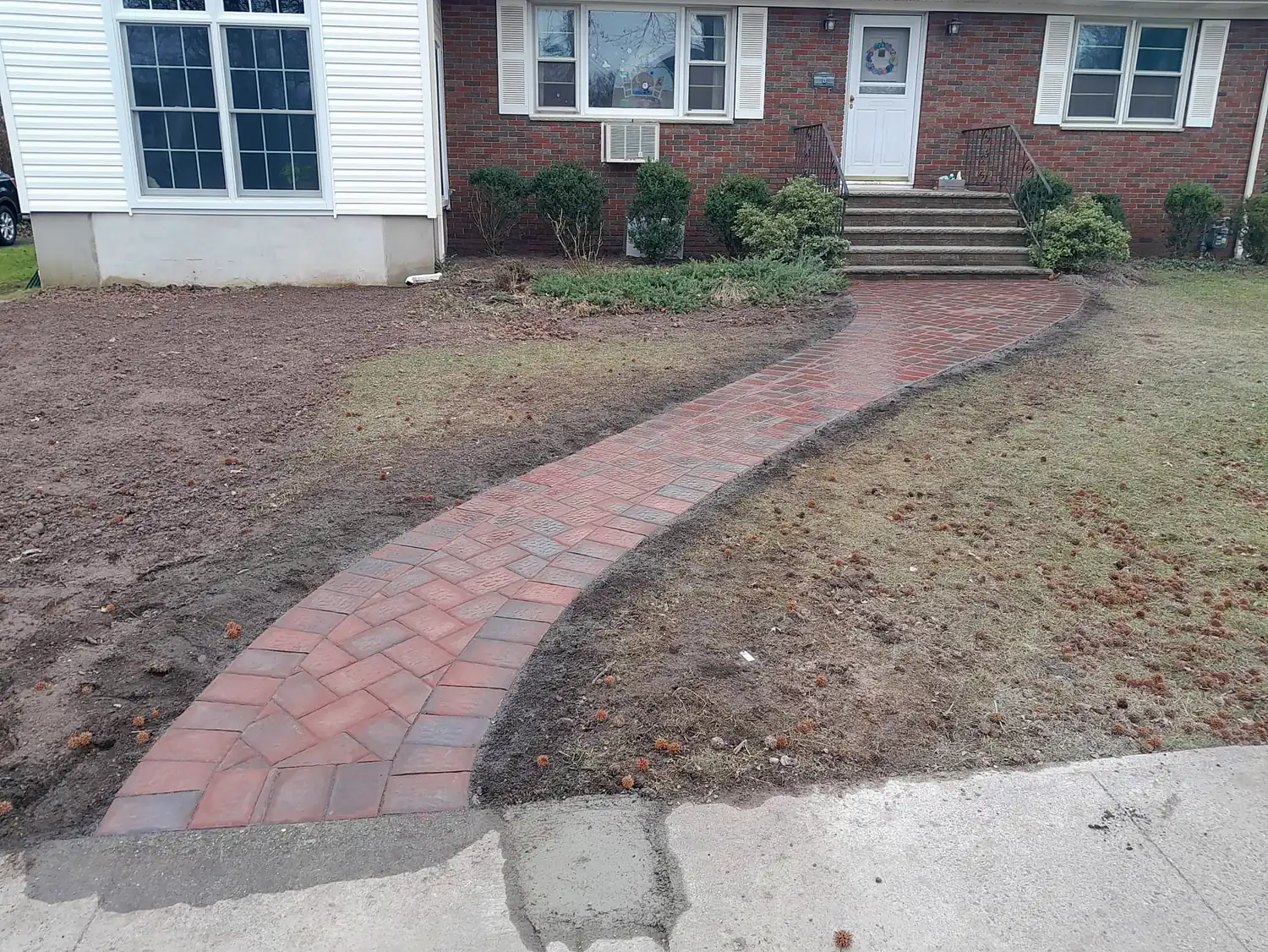
Paver walkways and front entries
More foot traffic per square foot than anything else on the property, so the base and the edges do the real work.
Why walkways move, and how to stop it
A walkway is narrow, which makes it look like a small job. It is also the most walked surface on a property, it sits next to lawns that get watered and beds that get dug, and it often runs right beside the foundation where roof water lands. Every one of those works on the base. When a walk heaves, sinks or opens up at the joints, the base has usually moved, and the pavers are only showing it.
So a walkway gets the same construction as a patio, scaled to the space: dug to real subgrade, built up in layers of compacted stone, bedded, laid, restrained at both edges and locked with joint sand.
How we build a paver walkway
- Excavation through the topsoil to firm ground, so the walk is not sitting on anything organic that will rot and settle
- A compacted stone base built in layers, each one compacted before the next goes on, rather than one thick lift
- Pitch so water runs off the walk and away from the house, never back toward it
- Edge restraint on both sides. A walkway has two long edges and nothing holding it in the middle, so without restraint the field creeps outward and the joints open.
- Joint sand swept and compacted in, so the pavers lock together and act as one surface
Styles and materials
Interlocking concrete pavers are the most common choice, in a pattern and color that suit the house, often with a contrasting border to frame the path. Courtyard installs Cambridge pavers, and customers have named them in our Google reviews. Bluestone gives a flatter, more traditional look that suits older houses in towns like Montclair and Glen Ridge. Curves take more cutting than straight runs, and a curve that follows how people actually walk to the door is worth the extra cuts.
Front entries
The walk to the front door usually meets steps or a stoop, and the two are best planned together so the heights, materials and drainage line up. A new walk that meets tired steps makes both look worse.
Common questions
What is the average cost of a paver walkway?
The price follows the length and width, the paver and pattern, how many curves and cuts it takes, how much excavation the ground needs, and whether old concrete has to come out first. We measure on site and give you a written price. See what drives the price.
Is a paver walkway cheaper than concrete?
Poured concrete usually costs less to install. Pavers cost more up front and are easier to live with, because a section that settles or gets dug up for a pipe can be lifted and relaid with the same pavers. A patch in concrete always shows.
Can I lay pavers straight on dirt?
You can, and they will move within a season. Soil holds water, shifts with frost and settles unevenly. Pavers need a compacted stone base and a bedding layer to stay flat.
What is the cheapest way to do a walkway?
A gravel or stepping stone path costs the least and suits a side yard or garden route. For the main walk to the front door, the cheapest option that lasts is a simple paver pattern with a straight layout, since curves and borders add cutting time.
Can an existing walkway be repaired instead of replaced?
Often. If the pavers are in good shape, a sunken or heaved section can be lifted, the base corrected, and the same pavers relaid.
This page was last updated in September 2026.
Front walk heaving or sinking?
Call (973) 489-3642. A walk can often be lifted, rebased and relaid with the same pavers.